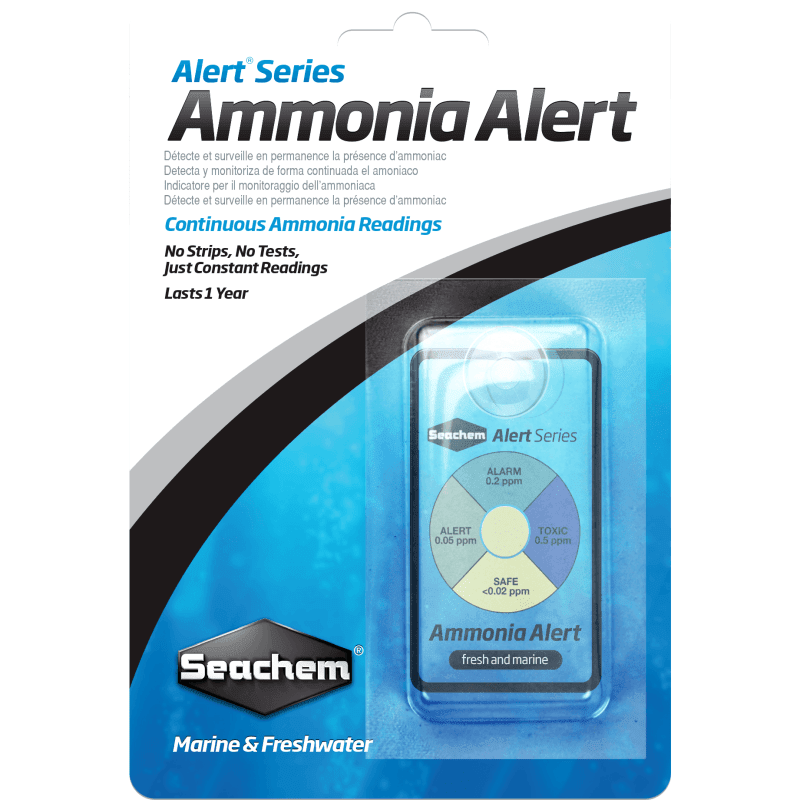

Seachem Ammonia Alert – Continuous Ammonia Monitor for Aquariums
Seachem Ammonia Alert – Continuous Ammonia Monitor for Aquariums
Shipping from $6.99 · FREE on orders of $ 99.99 or more
Spend $ 99.99 and shipping is free.
Couldn't load pickup availability
Spot the Number One Killer Before Your Fish Do
Free ammonia is the #1 killer in aquariums, and traditional test kits only tell you the moment you happen to run one. By the time your fish show stress, ammonia may have been climbing for hours.
Ammonia Alert is an innovative color device for continuously detecting and monitoring toxic free ammonia. A sensor changes reversibly from yellow to green to blue relative to the ammonia concentration, with no test kits, chemicals, or procedures needed. It detects less than 0.05 mg/L (ppm) free ammonia and lasts over a year, over 9 times as long as competing products and almost half the size, so it stays clear and unobtrusive.
Ammonia Alert is made by Seachem Laboratories, a chemistry-driven company founded in 1979 in Madison, Georgia, USA and staffed by its own chemists who develop each product in-house. That scientific approach is what sets the Alert series apart: most kits report total ammonia, but this sensor is engineered to respond only to the toxic free ammonia form, giving you an accurate, well-designed read on the exact fraction that endangers your fish.
- Place Ammonia Alert visibly in your aquarium, marine or freshwater.
- Let the sensor equilibrate with the water over a few days.
- Read the color at a glance and act the moment it signals rising ammonia.
Get around-the-clock protection against the silent killer. Add to cart.
What It Does
Ammonia Alert is an innovative color device for continuously detecting and monitoring toxic free ammonia. A sensor changes reversibly from yellow to green to blue, relative to the ammonia concentration. No test kits, chemicals, or procedures are needed. The device detects less than 0.05 mg/L (ppm) free ammonia and alerts you to the #1 killer before any sign of stress. It lasts over a year. Marine or freshwater use. Ammonia Alert lasts over 9 times as long as competing products (over a year compared to 4-6 weeks) and is almost half the size of competing products (1.5" x 2.5").
How to Use
In the absence of free ammonia the unit will assume a yellow or faint yellow-green color. It is normal for the dry sensor to have a greenish hue. It may take up to a few days for a dry sensor to equilibrate with the water. No sampling of water, chemicals, or test procedures are required. The presence of the free ammonia is detectable continuously with a response time of about 15 minutes. Response to decreasing ammonia is slower, requiring about 4 hours to go from TOXIC to SAFE on removal of ammonia.
Why Seachem Ammonia Alert
- Continuous, at-a-glance monitoring: the sensor works around the clock and changes color the moment free ammonia rises, so you are not relying on a test you happened to run in time.
- Reads only the toxic free ammonia: it responds to the free ammonia form that actually harms fish, detecting less than 0.05 mg/L before any sign of stress.
- No reagents or procedures: no water sampling, chemicals, or test steps, and its reversible yellow-to-green-to-blue color change keeps tracking conditions live.
- Long-lasting and unobtrusive: lasts over a year, more than 9 times as long as competing products, and is almost half the size (1.5" x 2.5") so it stays clear in the tank.
Best For
Ideal for new and cycling tanks, quarantine and hospital setups, and any aquarist who wants hands-off, ongoing reassurance against ammonia spikes. It suits both marine and freshwater aquariums, making it a fit for reef, community, and planted tanks alike.
FAQ
Freshwater or saltwater? Ammonia Alert works in both marine and freshwater aquariums.
How long does it last? It lasts over a year, more than 9 times as long as competing products that typically last 4-6 weeks.
Does it read total or free ammonia? It reads only the toxic free ammonia, changing reversibly from yellow to green to blue and detecting less than 0.05 mg/L.