
Seachem de*nitrate – Natural Nitrate-Removing Bio Media
Seachem de*nitrate – Natural Nitrate-Removing Bio Media
Shipping from $6.99 · FREE on orders of $ 99.99 or more
Spend $ 99.99 and shipping is free.
Couldn't load pickup availability
Drive Down Nitrate the Way Live Rock Does
Even with regular water changes, nitrate creeps upward and stresses sensitive fish and corals. Most media only handle ammonia and nitrite, leaving the final, stubborn stage of the cycle unaddressed.
de*nitrate is an economical, natural, porous material whose pore distribution and geometry promote aerobic nitrification within the first few millimeters and anaerobic denitrification at the core. It removes nitrate by the same anaerobic process as live or reef rock, but magnifies efficiency several fold by forcing water through its high surface area. It doubles as an excellent aerobic biological filter, making it ideal for drip trays, canister filters, sumps, and box filters.
de*nitrate is developed in-house by the chemists at Seachem Laboratories, the chemistry-driven company founded in 1979 in Madison, Georgia. That science-first engineering is what gives de*nitrate its carefully tuned pore geometry and high surface area, so a modest amount of media supports the dense bacterial colonies needed for effective, high-capacity nitrate removal.
- Rinse off dust, then place de*nitrate where water flows through it, such as a canister filter or box filter.
- Keep flow at or below 200 L (50 US gallons) per hour so an anaerobic core can develop.
- Use enough (each 500 mL treats about 100 to 200 L) and watch nitrate fall and level off over several days.
Give your reef the low-nitrate water it needs. Add to cart.
What It Does
de*nitrate is a natural, porous material that promotes aerobic nitrification within the first few millimeters of depth and anaerobic denitrification at the core. It has a high surface area and supports a high density of bacteria. Its primary mechanism of nitrate removal is anaerobic, the same process by which live or reef rock removes nitrate, with efficiency magnified by forcing water through the porous material. Excessive flow rates should be avoided as they impede the anaerobic environment. At high flow rates (greater than 100 US gallons per hour) it functions solely as an aerobic filter; at slow flow rates (less than 50 US gallons per hour) it functions as both an aerobic filter and an anaerobic denitrifying filter.
Directions
For best results, de*nitrate should be placed to assure the flow of water through it, such as in a canister filter, chemical filtration module, or box filter. Flow rate should not exceed 200 L (50 US gallons) per hour. If higher flow rates are unavoidable, use Matrix or Pond Matrix. It is best to rinse off dust before use. Once de*nitrate has been in use for several days, nitrate concentrations should start to fall and level off gradually at a concentration of about 4–5 mg/L as nitrate. As long as nitrate concentrations remain under control, the product is not exhausted. Each 500 mL of de*nitrate treats about 100–200 L (25–50 US gallons), depending on initial nitrate concentration and the current biological load. Enough should be used to remove nitrate at a rate at least as fast as the rate of formation. If very high nitrates are initially present, they should be brought down to less than 20 mg/L with water changes.
Available Sizes
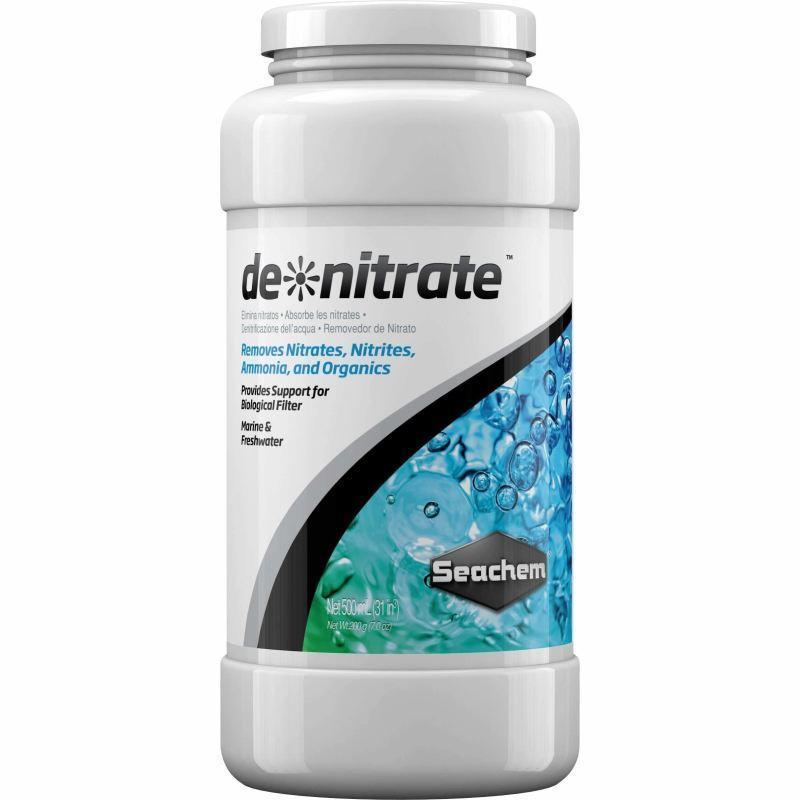
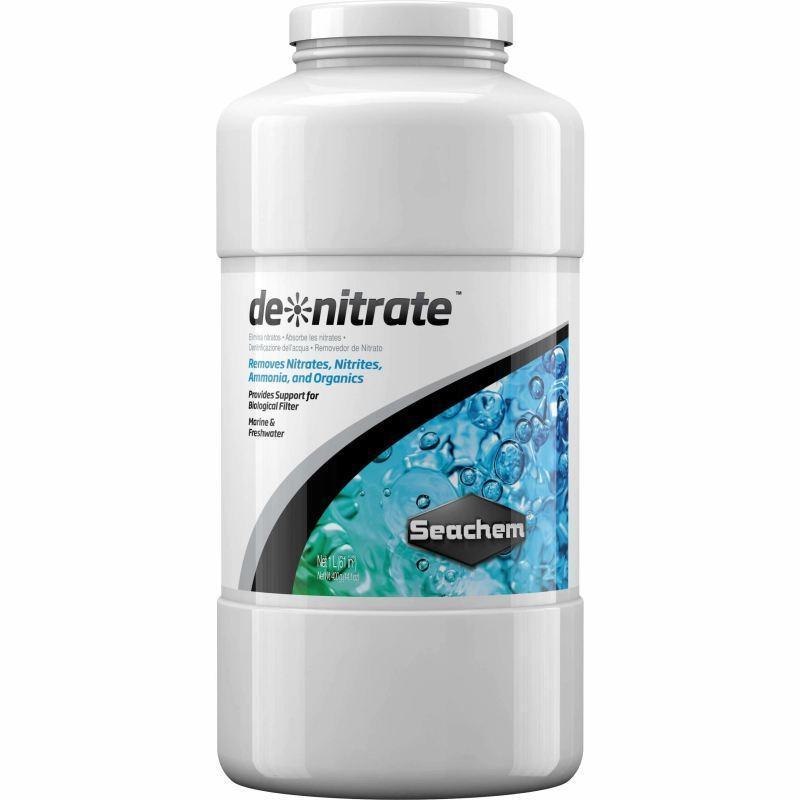
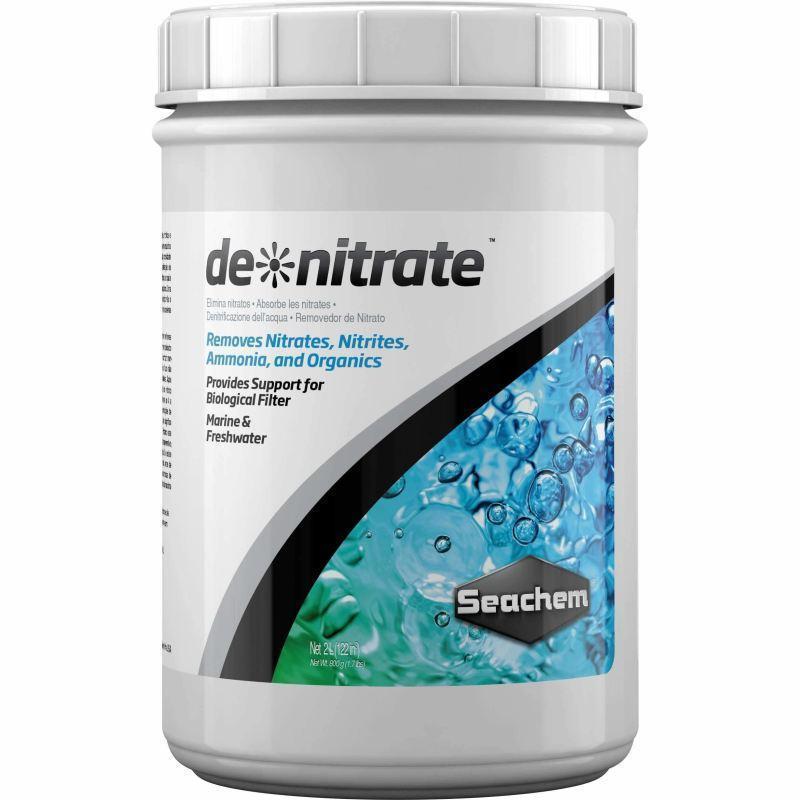
100 mL, 250 mL, 500 mL, 1 L, 2 L, 4 L
Why Seachem de*nitrate
- Removes the nitrate other media leave behind: its anaerobic core drives denitrification the same way live or reef rock does, tackling the final stage of the cycle.
- Dual-purpose biofiltration: the outer few millimeters run aerobic nitrification while the core runs anaerobic denitrification, so it also serves as an excellent aerobic biological filter.
- High-capacity porous surface: its natural pore geometry and high surface area support a high density of bacteria, magnifying nitrate removal several fold over passive rock.
- Flow-tuned and filter-flexible: ideal for drip trays, canister filters, sumps, and box filters; keeping flow at or below 200 L (50 US gallons) per hour lets the denitrifying core develop.
Best For
Reef, marine, and freshwater aquariums where nitrate remains stubbornly high despite water changes. Especially valuable for reef keepers and sensitive freshwater setups running canister filters, sumps, or box filters at controlled flow rates.
FAQ
How long does it last, and when is it exhausted? As long as nitrate concentrations remain under control, the product is not exhausted. After several days of use nitrate should fall and level off around 4–5 mg/L. Each 500 mL treats about 100–200 L (25–50 US gallons) depending on load.
Where does it go in my filter? Rinse off dust and place it where water flows through it, such as a canister filter, chemical filtration module, or box filter, with flow not exceeding 200 L (50 US gallons) per hour so the anaerobic core can form.
Freshwater or marine? Both. It works as an aerobic and anaerobic filter in freshwater and marine systems; if you cannot keep flow low, use Matrix or Pond Matrix instead.